09/11/2021

Asus TUF Gaming A15 FA506 Screen Replacement

[vc_video link=”https://www.youtube.com/watch?v=dGPDjEoqbCE” title=”Asus TUF Gaming A15 FA506 Screen Replacement”]

ASUS TUF Gaming Laptop (Model ASUS 506) Screen Replacement Guide

Hi, Simon here. Today, I’m going to walk you through a screen replacement for an ASUS TUF Gaming Laptop, model ASUS 506. Before we start, please hit the like button and subscribe for more content!

Tools and Parts Needed

  • Phillips screwdriver
  • Metal prying tool
  • Replacement screen (links for purchase in the description)

Steps for Screen Replacement

1. Powering Off and Preparing the Laptop

  • Make sure the laptop is turned off.
  • Identify the hidden screws under the stickers near the screen hinges.

2. Removing the Bezel

  • Carefully peel off the stickers and unscrew the hidden screws.
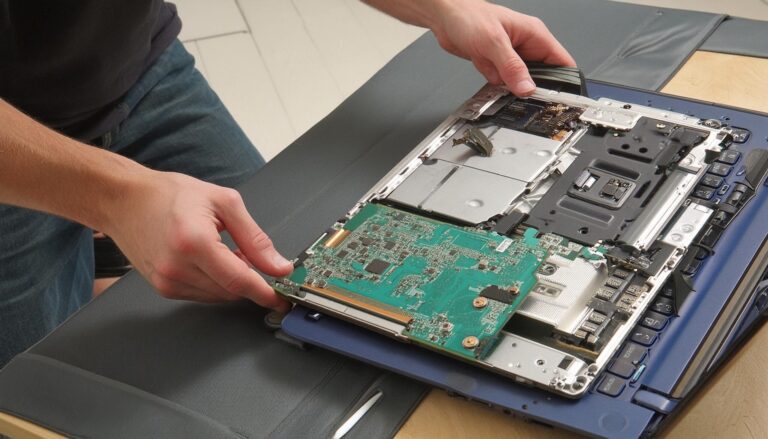
  • Use a metal prying tool to gently pop open the bezel, starting from a weak spot.
  • Work your way around the bezel, being mindful of the double-sided tape along the bottom.

3. Removing the Damaged Screen

  • The LCD screen is attached with double-sided tape. Pull the tape strings gently towards you to release the screen.
  • Carefully tilt the screen forward and disconnect the screen cable by sliding it away from your body.

4. Preparing and Installing the New Screen

  • Assuming you’ve acquired the replacement screen (model number: LP156WFC-SPD1), prepare to attach it.
  • Get double-sided adhesive tape (link in description). Measure and cut the tape to fit the screen sides, leaving some excess.
  • Remove the tape backing and align the new screen.
  • Reconnect the screen cable by sliding it towards your body and securing it with the tape.
  • Press the screen down gently to adhere it to the tape.

5. Reassembling the Laptop

  • Carefully place the bezel back, ensuring it snaps into place.
  • Replace the screws and stickers over the hinges.
  • Power on the laptop to test the new screen.

That’s it for this screen replacement tutorial for the ASUS TUF Gaming Laptop, model ASUS 506. If you have any questions, please leave them in the comments below. Remember to like and subscribe for more tutorials like this. Take care, and see you in the next video!

Legal Disclosure:

UberGeeks video(s) or information provided on this website does not, and is not intended to, constitute legal advice, constitute IT professional advise, information technology expert, or tech related material; instead, all information and content available on this are for entertainment purposes only. No information contained in this video shall create any express or implied warranty or guarantee of any particular result.

UberGeeks shall not be held liable for any damages, losses, injuries, loss of data, or harm arising from the use of information or techniques presented in our video(s) or information provided on this website. By accessing and using our content, you agree to release us from any liability.

Participation in any activities or experiments presented in our video(s) is entirely voluntary. If you choose to replicate any actions or experiments, exercise caution, and prioritize your safety and the safety of your equipment.

Thank you for joining us on this IT journey. We hope you find our video(s) enjoyable. Remember, your participation in this channel is at your own discretion, and we encourage you to use the information responsibly and safely.

Transparency Note:

This article was collaboratively written with the assistance of ChatGPT, an AI language model developed by OpenAI. While the content was generated with AI assistance, it was reviewed and edited by our human editorial team to ensure accuracy and quality. As part of our efforts to enhance the user experience, we utilize artificial intelligence (AI) technologies to generate images and visual content on this website. Adobe Firefly AI-generated images may include graphics, illustrations, and other visual elements.
Related Articles